Pigment Index › Blues › Prussian Blue
Prussian Blue
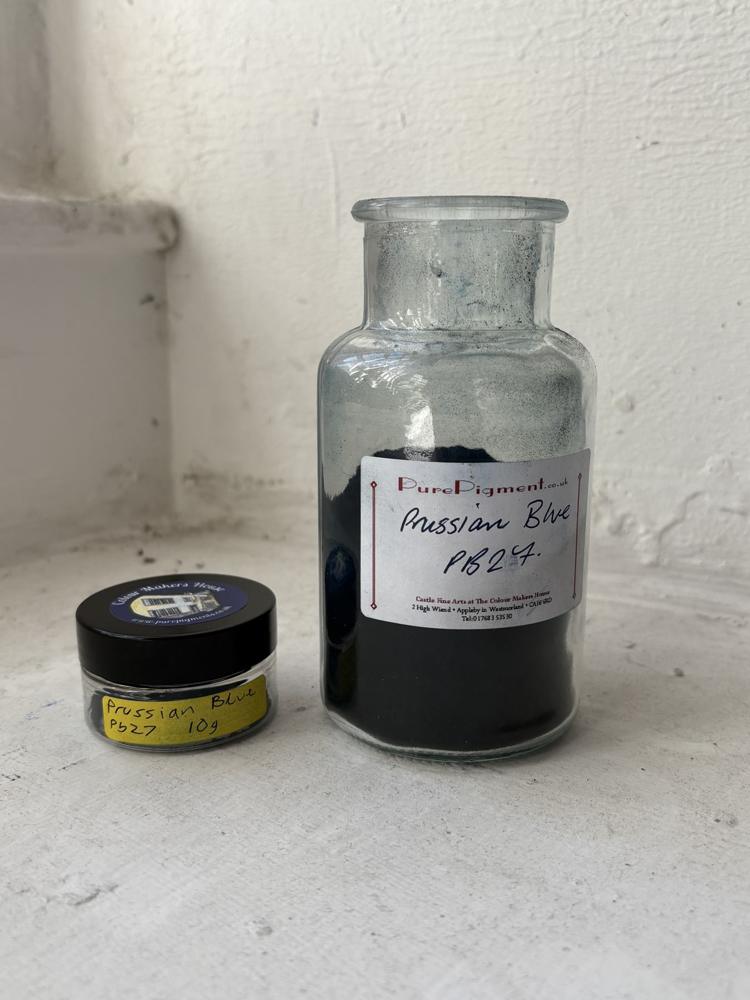
An accident in a Berlin colour workshop gave painters a deep, cheap blue at last. At the bench it still startles: two pale yellow liquids meet and the vessel floods with a blue so deep it looks almost black. As the filtered cake dries it shrinks by around 80 per cent, leaving a small, dense cake of colour.
The story
Prussian Blue was discovered by accident in Berlin in the first years of the eighteenth century, though early accounts disagree on whether it was 1704 or 1706. The paint maker Johann Jacob Diesbach, working for Johann Leonhard Frisch, was making a red lake from cochineal when contaminated potash, said to have come from the alchemist Johann Konrad Dippel, turned his batch a deep, startling blue. Unlike vermilion or verditer, it had no natural mineral twin, which is why it is often called the first modern synthetic pigment.
The Berlin makers kept the method secret for nearly twenty years while Frisch sold the blue across Europe. The secret broke in 1724, when John Woodward printed a recipe in the Philosophical Transactions of the Royal Society, calling for dried blood, potash, alum and iron vitriol. The account naming Dippel came later, from Georg Ernst Stahl in 1731.
Before Prussian Blue, painters wanting a deep blue had costly ultramarine, azurite that could turn green, or dull smalt. The new blue was vivid, versatile and far cheaper, and by the 1720s Watteau, Hogarth and Gainsborough were all using it. It travelled to Japan as bero-ai, Berlin blue, and gives Hokusai's Great Wave off Kanagawa its electric depth. In 1842 Sir John Herschel used it to invent the cyanotype, which gave the world the blueprint.
It has a Cumbrian story too. From 1798 the chemical works at Copperas Hill, Harrington, on the West Cumberland coast, turned pyrites from the local coal pits into vitriol, and among its documented products was Prussian Blue. The chain runs from fool's gold to copperas, to ferric sulphate, to blue: the same iron that stains the North Pennine becks orange.
How it behaves
Prussian Blue is permanent in oil, though in watercolour it can fade under strong light, so keep finished watercolour work out of direct sun. It is very transparent and heavily staining, so a little goes a long way, and it is superb for glazing and for mixing natural greens with yellow ochre, or warm greys with burnt sienna. It suits linseed oil, watercolour and egg tempera, and a wetting agent helps it disperse fully. It dries quickly in oil and can wrinkle if laid on too fast. Avoid alkaline materials such as lead white, calcium carbonate, lime and fresco, which can turn it brown; for the same reason it isn't suited to acrylic binders.
Buy it, make it, hear it, read it
Buy it
Prussian Blue
10g tester £3.99 · 50g Artist's Working Pot £17.50 · 20ml glass vial £8.55
Buy Prussian BlueMake it
Alchemy Master
Precipitate a blue from iron yourself, the way it was first made.
See the workshopHear it
The Blue Talk
The story of blue, from lapis lazuli to the accident in Berlin, for societies, WIs and clubs.
Book a talkSources
- Woodward, J. (1724). 'Praeparatio Caerulei Prussiaci ex Germania missa ad Johannem Woodward', Philosophical Transactions of the Royal Society 33, pp. 15–17.
- Stahl, G. E. (1731). Experimenta, observationes, animadversiones, CCC numero, chymicae et physicae. Berlin.
- Kraft, A. (2008). 'On the discovery and history of Prussian Blue', Bulletin for the History of Chemistry 33(2), pp. 61–67.
- Berrie, B. H. (1997). 'Prussian Blue', in Artists' Pigments, Vol. 3, ed. E. W. Fitzhugh. National Gallery of Art, Washington DC, pp. 191–217.
- Baird, T. & Doyle, A. (2004). Pigment Compendium. Butterworth-Heinemann, Oxford.
- Ware, M. (1999). Cyanotype: The History, Science and Art of Photographic Printing in Prussian Blue. Science Museum, London.
- Cumbria County History Trust. 'Making Sulphuric Acid on Copperas Hill (Background: Harrington)'. cumbriacountyhistory.org.uk.
Still being made here, by hand.