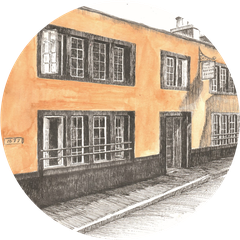
The Colour Makers House
A Stuart townhouse, once the Black Boy hostelry.
2 High Wiend stands on one of the narrow medieval lanes running off Boroughgate. Its datestone reads 1677. For many years it was a hostelry called the Black Boy. Today it is a working colourman's shop, and the building is as much a part of the story as anything made inside it.
Layers of history
One building, four lives
- MedievalA hall house on High WiendThe present building stands on the footprint of an earlier medieval hall house, on a plot in one of Appleby's narrow, defensible lanes, with outbuildings set at right angles to the main range.
- 1677Rebuilt in the Stuart styleThe datestone records the rebuilding, the year after Lady Anne Clifford's death in 1676, as Appleby recovered from the Civil War. Two storeys, stuccoed, with traces of timber framing still inside. A surprisingly grand staircase rises to a first floor of unusually high ceilings, almost a piano nobile, far grander than a modest lane might suggest.
- 1754On the town mapThe 1754 political voting map of Appleby, held by the Westmorland Archaeological Society, shows the building with a side passage leading through to a communal yard.
- c.1677–1897Two hundred years as the Black BoyFor roughly the first two centuries of its life the building was a hostelry called the Black Boy, a reminder that High Wiend was a place of trade and hospitality as well as defence. Its last owner was a signalman on the Settle–Carlisle Railway.
- 1897Sold at auctionWhen the Black Boy went under the hammer, the inventory listed 24 truckle beds, 2 feather beds and a four-poster: a crowded house of low beds rolled out for travellers, and one grand bed for whoever could pay for it. The inventory survives in the collection of the Westmorland Archaeological Society.
- 1912The passage closesThe High Wiend post office was built across the old side passage, ending one chapter of the building's working life.
- 1951Listed Grade IIHistoric England listed 2 High Wiend on 6 June 1951 for its special architectural and historic interest (List Entry 1311602).
- 20th centuryA chequered historyIn the years that followed, the building was an antique shop, then a restaurant, then Desi Spice, before standing empty for some twenty years.
- TodayThe Colour Makers HouseBrought back to life as a pigment workshop and traditional colourman's shop, where colour is still made by hand on the ground floor of a house that has been changing use for more than three centuries.
About the name
Why the Black Boy?
Inns called the Black Boy were common across England from the seventeenth century. Historians point to more than one origin: a nickname for the young, dark-haired Charles II, and signs depicting Black servants, which reflect Britain's part in the transatlantic slave trade.
We have not yet found which story belongs to this house. We would rather tell you that plainly than guess, and if you know more, Mark would love to hear from you.
Inside the House
What you'll find on each floor
Ground floor
Shop and demonstration room
Where The Alchemy Hour runs and the pigments, gift boxes and mullers are sold. No front step, so wheelchairs can get in. Tight turns into the shop and workshop make mobility scooters harder.
First floor
Office and studio
Up the grand staircase. Open by appointment, and to all visitors on Heritage Open Days.
Out the back
Courtyard and garden
A door from the pigment room leads through the courtyard and garden back to High Wiend.
There are no toilets in the House. Public toilets are on Boroughgate opposite the Moot Hall coach stop, about three minutes' walk away.
Open doors
Heritage Open Days
Each September the first floor opens to everyone. In 2026 the House hosted Whose Hands Made Red Gold?, nine boards tracing cochineal from Aztec Mexico to George and Lady Anne Clifford and back to this bench.
[2027 dates to confirm]
Visit the House
Open 9.00 to 16.00, Monday to Saturday. Demonstrations daily at 11am and 1pm unless a workshop is booked.
Still being made here, by hand.